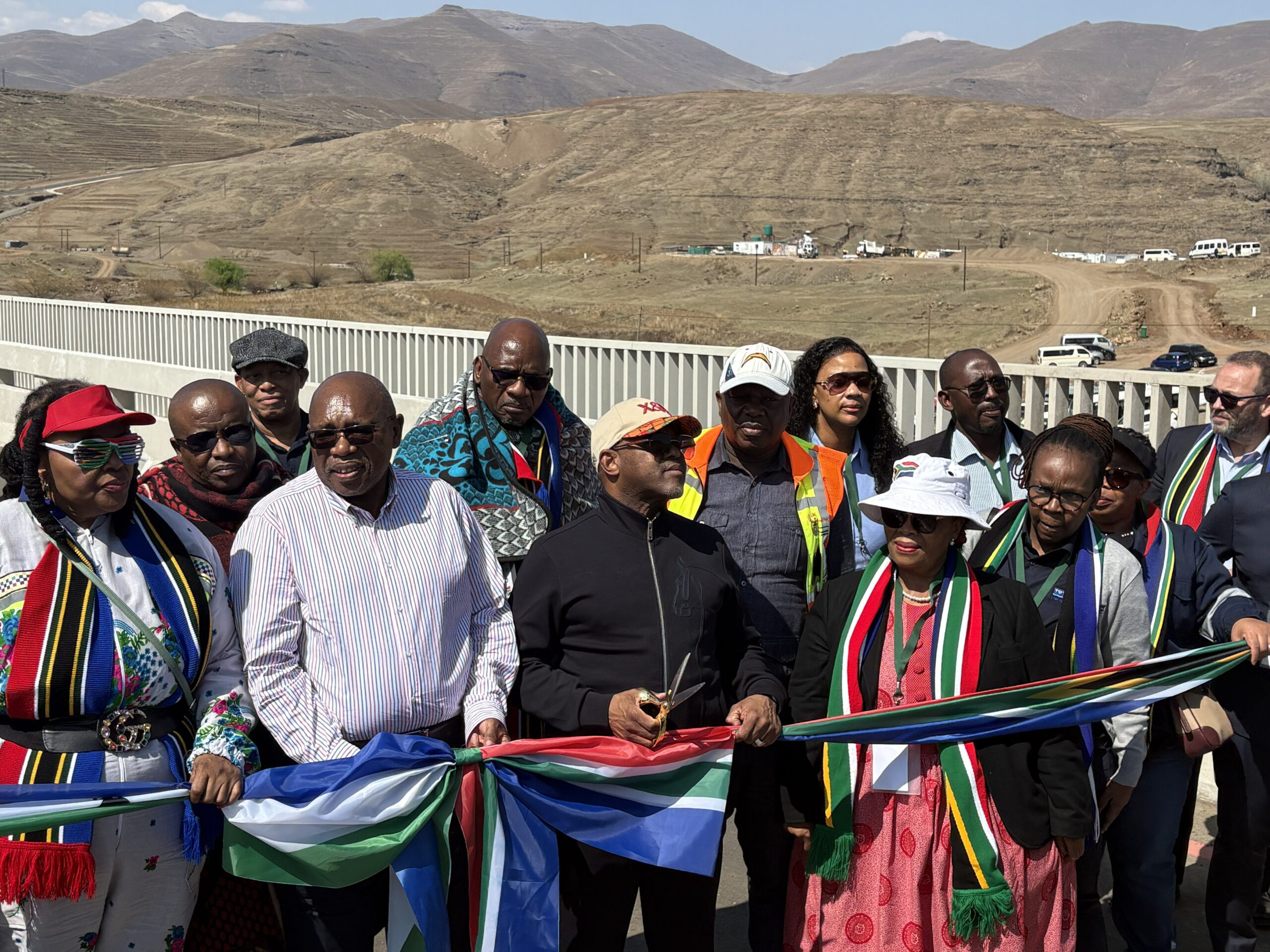
Two bridges mark major LHWP-2 milestone
By Luzamo Sandlana
Two major bridges forming part of Phase II of the Lesotho Highlands Water Project (LHWP-2) were officially launched on 11 September 2026, marking another major step in the project’s implementation.
The Khubelu and Mabunyaneng bridges are two of three major bridges constructed under LHWP-2. Their launch follows that of the Senqu Bridge earlier this year, meaning all three major bridges have now been officially launched.
South Africa’s Minister of Water and Sanitation, Pemmy Majodina, and Lesotho’s Minister of Natural Resources, Mohlomi Moleko, jointly officiated the ceremony.
TCTA CEO Percy Sechemane, who attended the ceremony alongside Board Chairperson Precious Sibiya, said the milestone was particularly significant for TCTA as the project’s funding agent.
“As the funding agent for the project, this marks a huge milestone for TCTA. This is a significant project to implement, and each time we witness developments such as these, we see tangible evidence of the progress being made,” Mr Sechemane said.
The Khubelu and Mabunyaneng bridges are located within 500 metres of each other at the confluence of the Mabunyaneng and Khubelu rivers, about 22 kilometres from the Senqu Bridge. They are designed to remain open and usable when the Polihali Reservoir reaches full supply level, helping maintain access and connectivity in the area.
The Khubelu Bridge, the second largest of the three major bridges, has a 270-metre curved deck comprising nine 30-metre spans. Eight piers and two abutments support it, and it stands about 25 metres above the valley floor. Construction of the spans required 63 precast beams, each weighing 52 tonnes.
The Mabunyaneng Bridge is 120 metres long and comprises four 30-metre spans supported by three piers and two abutments. It stands about 12 metres high and required 28 precast beams, each weighing 52 tonnes.
A distinctive feature of the Mabunyaneng Bridge is its 190-metre-long, nine-metre-high mechanically stabilised earth retaining wall, constructed from more than 700 reinforced earth panels. The design enabled the existing A1 road to remain open to traffic while the new alignment was raised above the future reservoir level.
Both bridges are 13.55 metres wide, with an eight-metre carriageway and two-metre walkways on either side. The works also included realigning a two-kilometre section of the A1, retaining walls, stormwater drainage and road-safety infrastructure.
Safety features include barriers designed to redirect errant vehicles back onto the roadway and higher-than-standard anti-climb handrails to protect pedestrians, cyclists and people travelling on horseback.
With the launch of the Khubelu and Mabunyaneng bridges, all three major bridges constructed under LHWP-2 have now reached this milestone. Beyond their engineering significance, the bridges will help preserve access and connectivity around the future Polihali Reservoir as the wider Phase II infrastructure programme advances.